
A week between two lessons is the perfect interval for forgetting half of what your teacher showed you. Not through laziness, through physiology: without regular practice, procedural memory degrades quickly. The good news is that 5–10 minutes a day is more than enough. You just need to know what to do with them.
The classic problem with the week between lessons
Here is the scenario: your lesson is on Tuesday. Tuesday evening you come home motivated and play for 20 minutes, everything is fresh. Wednesday you have no time. Same on Thursday. Friday you tell yourself you will get to it, but you postpone. Saturday something else comes up. Sunday you sit down for 45 minutes and realise you have already lost two or three things from the last lesson. Monday you double down to catch up. Tuesday at your lesson, your teacher notices you have not really progressed.
This pattern (nothing, nothing, big block at the weekend) is almost optimal for forgetting. It is exactly the opposite of what motor learning requires.
Why 5 minutes a day beats 1 hour a week
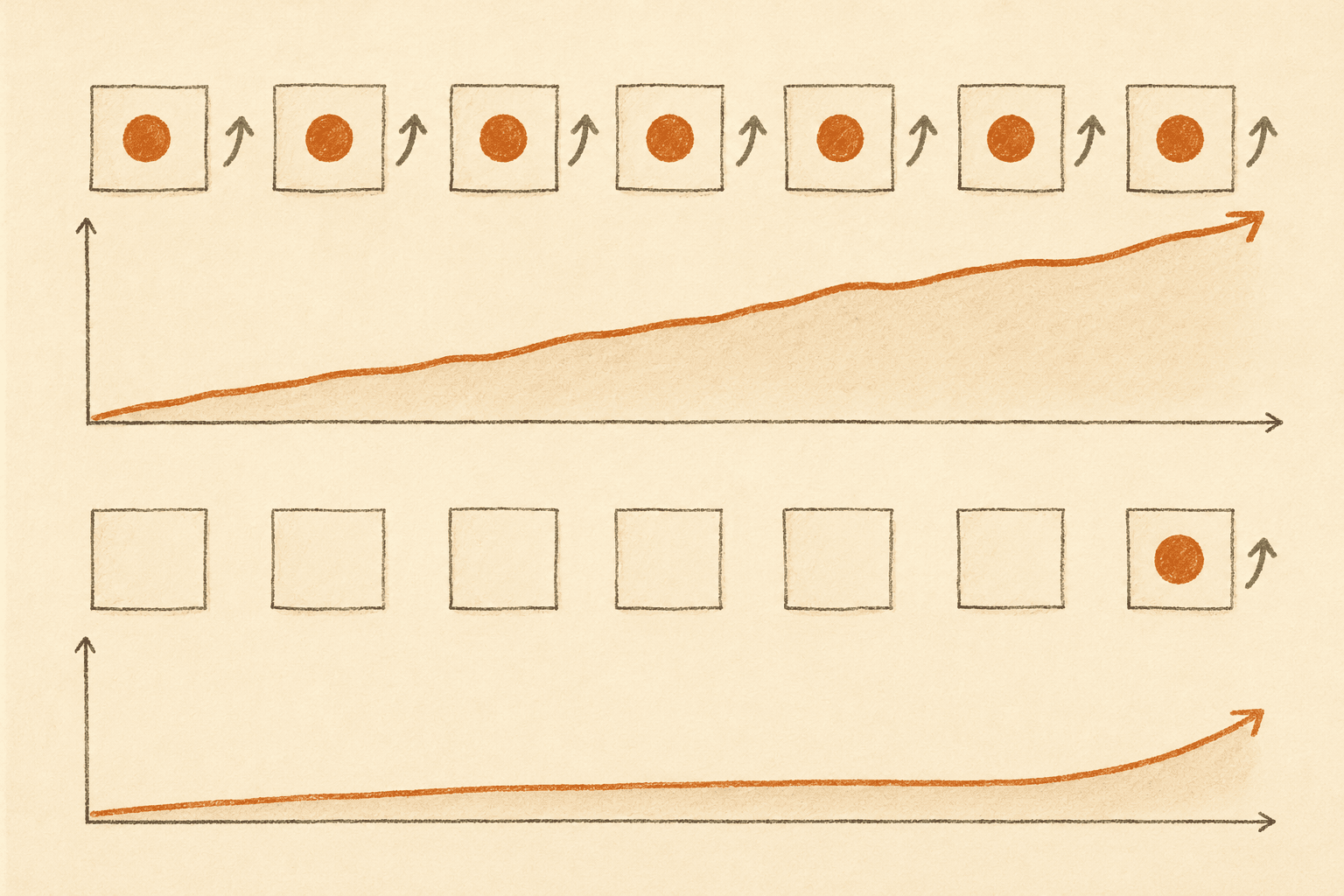
Procedural memory (the kind that lets you place an Am without thinking) consolidates during the sleep that follows practice. Each daily session triggers a night of consolidation. Seven sessions of 5 minutes = seven consolidations. One session of 35 minutes = one consolidation. The net benefit is far greater in the first case, even at equal total time.
This has been demonstrated in the scientific literature on motor learning for several decades, and every serious music educator knows it. If you only practise once a week, your progress will be 3 to 5 times slower than if you split the same time into short daily sessions.
Practical consequence: if you only have 35 minutes to give to guitar this week, do not do them all on Sunday. Split them into 7 × 5 minutes. You will genuinely progress faster.
What to put in your 5–10 daily minutes
Not just anything. The golden rule: revise what you already know, introduce nothing new. Learning new material is your teacher's job during the lesson. Your job between lessons is to consolidate, to arrive at the next lesson with the foundations of the previous one solid, ready to receive what comes next.
Here is a breakdown that works for 95% of students:
- 30 seconds: wake up your fingers. A few slow movements, light stretches. Do not skip this, playing cold causes injury over time.
- 2 minutes: play the exercise or piece your teacher gave you, without pressure, just to check it is still there.
- 3 minutes: do a chord shuffle with the chords from the last lesson plus the ones you already knew. The aim is to consolidate transitions between the old and the new.
- 1–2 minutes: play a snippet of a song you enjoy, any song, just to finish on something fun. Otherwise you associate guitar with homework, and you will stop wanting to practise.
The trap of "getting ahead for the next lesson"
A classic temptation: during the week, you find a YouTube video explaining a technique your teacher has not covered yet. You decide to get ahead. Bad idea.
First, you will probably learn a variation that contradicts your teacher's pedagogy. You arrive at the lesson with a movement to unlearn, which will cost more time than you gained. Second, you divert your daily 5 minutes from consolidation work to novelty work , so you weaken the foundations in favour of something you will cover in the lesson anyway. Triple loss.
If you have extra energy and time, put it into consolidation, never into getting ahead. Your teacher will thank you.
How not to forget to practise
Everyone knows they should practise. The real challenge is actually doing it. A few tricks that genuinely work:
The visual trigger
Leave your guitar out of its case, on a stand in plain sight in the room where you spend the most time. If you have to open a case to start, you will not start. If it is right there, ready to be picked up, you will pick it up spontaneously.
Attaching it to an existing habit
Link your practice to something you already do every day. "After my morning coffee" or "before I brush my teeth at night". Not "when I have time", you will never have time. The daily slot must already be reserved in your head.
The bare minimum
Set a very low minimum: 3 minutes. Not 10, not 15. Three. The point is not to do exactly 3 minutes, it is that you can never have an excuse not to start. Most of the time, once the guitar is in your hands, you will play for 10 or 15 minutes naturally. But on bad days, 3 minutes is infinitely better than zero.
The written record
Keep a practice log. One line per day, just to tick off. No pressure: if you skipped, you skip the line. But visually, seeing a row of ticked boxes creates a motivation not to break the chain. This is exactly the principle behind streaks in language apps, it works.
Tools that help
A good shuffle app automates the tedious part of short sessions: deciding what to play, managing the pace, giving objective feedback. Without an app, you spend part of your 5 minutes deciding what to work on, friction that discourages you from starting. With an app, you launch and play.
On the microphone side, chord detection gives you feedback you would not otherwise have: your own ears are biased (you played, you know what you were trying to play, so your brain "hears" it). A system that does not know what you were attempting, and has to guess from the sound alone, gives you the honest verdict. If the app cannot recognise your chord, something is off.
The worst trap: "I have time today" sessions
You have a free afternoon, so you decide to have a proper session. You play for 45 minutes. You come out satisfied. And then you do not play the next day because "I worked hard yesterday".
Wrong move. These long sessions replace multiple short sessions in your head while only counting as one. You feel virtuous, you deactivate your daily routine for the rest of the week, and you come back to the next lesson underprepared. Progress happens through consistency, not bursts of effort.
If you have a free afternoon, split it: 10 minutes of guitar, 30 minutes of something else, 10 minutes of guitar in the evening. You double your consolidations without doubling anything.
In summary
- 5–10 minutes a day, 5–6 days a week. Daily beats weekly.
- Revise, do not explore. New material belongs in the lesson.
- A shuffle on your known chords + a bit of the current piece = optimal format.
- Leave your guitar visible. Link it to an existing habit. Tick off your days.
- Watch out for long sessions that make you skip the following days.
If you want to automate the shuffle side so you never have to decide what to work on, select your chords and then start a session. It is designed for exactly these short sessions: 5 minutes, no complicated menus.