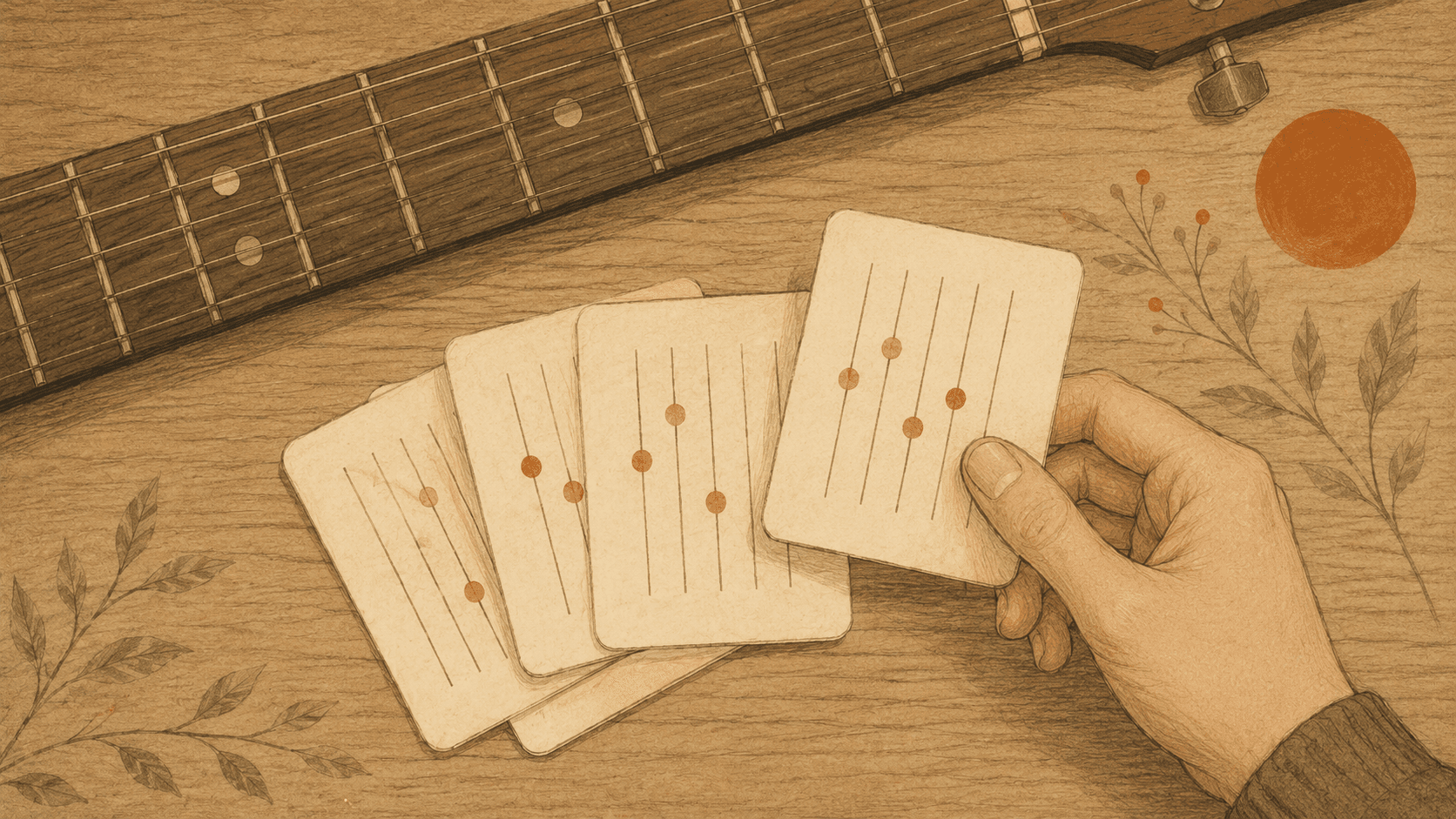
You know your chords. You can chain them smoothly in your favourite songs. Yet the moment you step outside your comfort zone, your fingers hesitate. The reason is simple: you know sequences, not chords. The chord shuffle exercise forces you to truly know each chord on its own terms.
What a chord shuffle is
A chord shuffle is a random sequence of chords. Instead of always playing the same progression (the eternal Em-Am-C-G loop), you play a sequence drawn at random on the spot: Em-G-D-Am-C-Em-D-G. Then another sequence. Then another. Every session, the order changes. It is that simple, and that powerful.
A useful image: you know how to swim breaststroke because you know the movement, not because you know a choreography. The chord shuffle is what turns a catalogue of memorised chords into a real skill, the ability to move from any chord to any other.
Why it is the most effective exercise you can do
When you practise a song, you practise a sequence. You memorise the order. The problem: your hand memorises the order too. Em always comes after G in your head. The day someone asks for G after Em, the opposite, your fingers hesitate. You thought you knew Em. In reality you knew "Em-comes-after-G".
The chord shuffle breaks this sequence effect. By drawing chords at random, it forces you to find every chord from any starting point. It is literally the proof test: if you pass three shuffles in a row with your first five chords, you can honestly say you know them. Otherwise, you knew a progression.
Pedagogical bonus: the shuffle also trains mental flexibility. You no longer anticipate the next chord, you see or hear it and react. That is exactly the skill you will need when playing in a group, improvising, or learning a new song quickly.
How to practise the chord shuffle by hand
You do not need an app to get started. Here is the paper method:
- Write each chord you know on a card or scrap of paper. Say you have eight chords.
- Shuffle them. Place the pile face down.
- Flip the first card. Play the chord. Flip the next. Play. Keep going until the pile is finished.
- Start again. This time, try to eliminate the dead time between chords.
- When you pass three rounds in a row without hesitation, add a new chord to the pile.
This is the manual version. It works, but it is slow: flipping cards, writing chord names, managing the pile. After a few sessions, the urge to do something else creeps in.
The modern version: shuffle + microphone detection
A shuffle app automates the tedious part and adds a layer of immediate feedback. Today's apps (including ours) listen through the microphone and recognise the chord you play. In practice:
- The app displays a chord to play.
- You play it.
- The microphone analyses the frequencies heard and compares them to the target chord.
- Either the app validates and moves to the next chord, or it asks you to try again.
The advantage over paper is threefold. First, you can no longer fool yourself: if the app says "not right", there is a problem somewhere, often a string buzzing or a finger muting an adjacent string. You learn things you would never have noticed practising alone. Second, gentle gamification (a score, a streak) sustains motivation over time. Third, the pace is faster, you chain more chords in 5 minutes than you would in 20 with cards.
How long per session, how often
Short answer: 5 to 10 minutes a day, 5 or 6 days a week. Not more, not less. Here is why.
Under 5 minutes, you do not have enough time to warm up or complete enough repetitions for your brain to register the work. Over 10 minutes, you fatigue, concentration drops, you start playing on autopilot without correcting mistakes, and you risk locking in bad habits. Consistency beats intensity by a wide margin.
An effective session looks like this:
- 30 seconds: launch the app and select your chords for the day.
- 3–4 minutes: a first easy shuffle, just to wake the fingers up.
- 3–4 minutes: a second shuffle, focusing on eliminating dead time between chords.
- 1–2 minutes: optionally a third in fast mode, where you accept imperfections.
How many chords to include in your shuffle
At the start, two or three is plenty. Many beginners want to include their entire repertoire from day one, this is counterproductive. If you know eight chords but your shuffle keeps drawing the three weakest ones, you spend all your time struggling with those three and fail to consolidate the other five. A healthier strategy:
- Start with 3 solid chords. Do 2 or 3 shuffle sessions with only those 3 chords to get comfortable with the format.
- Add 1 weaker chord (one you know but that trips you up). With 4 chords total, you will encounter it more often, good opportunity to consolidate it without isolating it.
- Once that chord feels comfortable, add the next. Move forward one chord at a time.
The goal is not to have the largest possible catalogue, it is to have every chord in your catalogue working reliably. Mastering 6 chords beats skimming 15.
Variations to keep things fresh
After a few weeks of shuffling, you can mix up the exercise:
Rhythmic shuffle
Instead of waiting for validation between each chord, you play to a tempo (slow metronome, 60 BPM). You no longer have the luxury of searching for the position: you have to be there exactly on time. It is hard. It is also what will make you able to play in a group.
Eyes-closed shuffle
You see the chord, then close your eyes before playing. You test the proprioceptive memory of your fingers. If you struggle, it means you were playing by sight, not by position.
Silent shuffle
You place your hand in the correct position on the neck without strumming. The goal is to chain the positions, not the sound. Useful when you do not want to wake the whole house at 11 pm.
Key-based shuffle
Draw only chords from a given key (G major: G, Am, Bm, C, D, Em). You train your ear at the same time as your hand, you start to hear the chords "fit" musically.
Mistakes to avoid
- Wanting to go fast too soon. Fast transitions require clean transitions first. Slow and clean beats fast and messy.
- Skipping a chord you got wrong. If the app says it was not right, replay it. Passing over it teaches your brain that "almost" playing a chord is fine, exactly the opposite of what we want.
- Shuffling without the microphone (or without validation). You will automatically lower your standards: a half-good chord will seem good enough. External feedback is what drives real progress.
- Including too many advanced chords. A shuffle where half the chords challenge you is no longer a transition exercise, it is a learning session. Better a smooth easy shuffle than a choppy hard one.
Start your first shuffle
If you want to try the microphone version, ours works from any browser, no account required. Choose the chords you know, then launch the shuffle. Five minutes is enough for the first session, the goal is simply to get a feel for it. Consistency will do the rest.