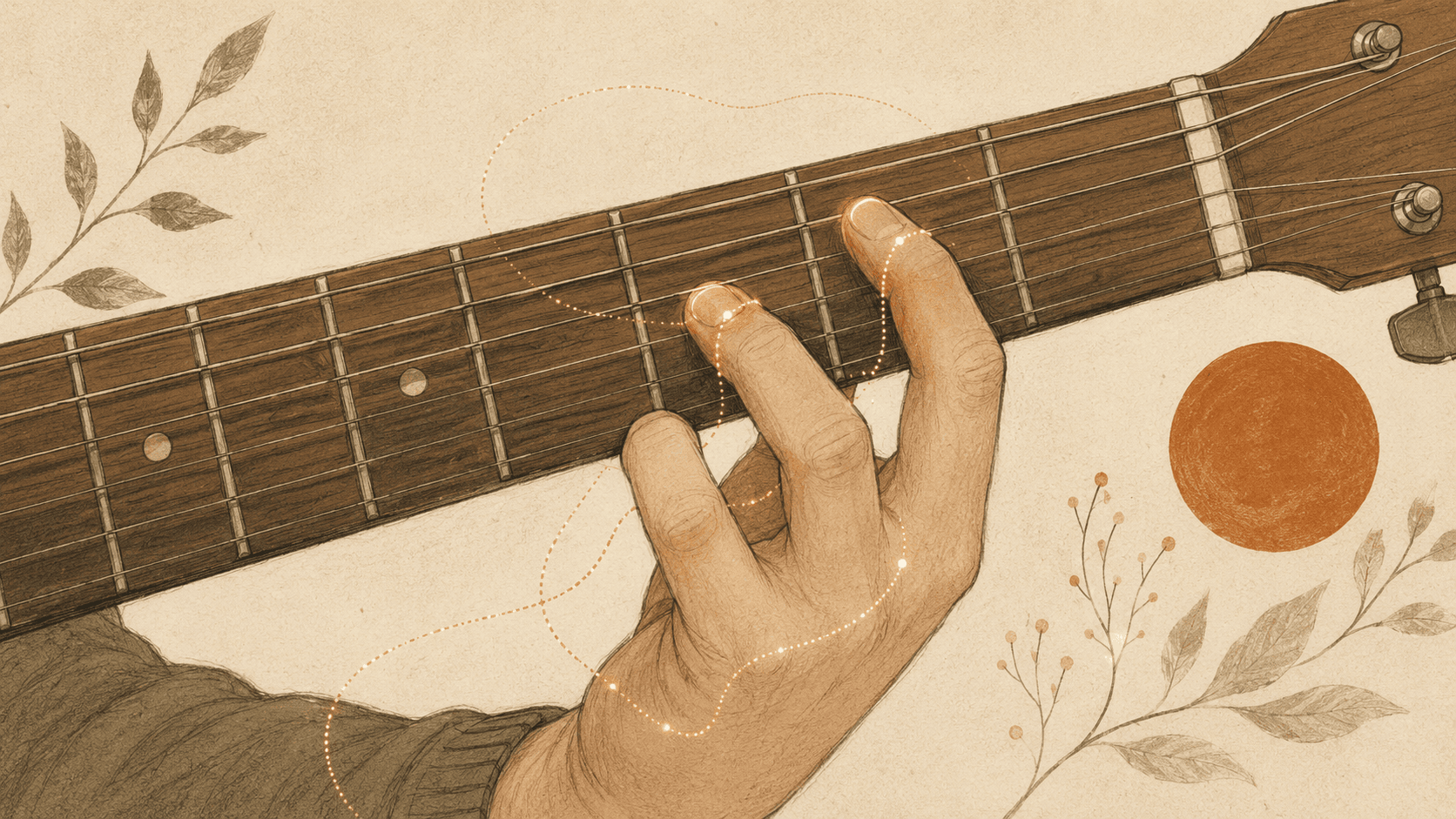
You learn a chord in your lesson. You get home, sit down, place your fingers, and nothing comes. What was right there two hours ago has completely vanished. You are not alone, and it has nothing to do with talent: it is mechanical. Here is how to make your hand remember.
Why chords are forgotten so quickly
Learning a chord is not learning a piece of information. It is training a movement. Your brain does not process the two in the same way. Information like "E minor is played with the middle and ring fingers on the second fret" is verbal and fragile, it holds for a few hours, maybe a day. The movement of placing those fingers in the right spot, however, must be encoded in procedural memory, the same memory that lets you tie your shoelaces without thinking. And procedural memory only learns through active repetition, not passive review.
In practice: reading a chord diagram ten times does not teach you the chord. Playing it ten times is not enough either, if you always play it in the same context. What actually teaches is retrieving the movement from different starting points, other chords, other positions, other tempos.
The classic mistake: practising each chord in isolation
Here is the trap almost every beginner falls into: you learn Em. You repeat it fifty times until you can play it comfortably. Then you move to Am. Same approach. Then C. Same again. You finish the session satisfied. But the next day, when you try to chain Em → Am → C, your fingers freeze between each chord. You know all three chords. You know zero transitions.
Yet playing guitar is 90% transitions. Nobody will ever ask you to hold a single Em for thirty seconds. They will ask you to move from Em to Am during a song. If you have only practised the chords themselves, you start from scratch on transitions every session.
The transition method
The real unit of learning is not the chord, it is the movement between two chords. Instead of repeating Em ten times, repeat Em → Am ten times. You work both chords and the transition simultaneously. You replace a fragile exercise (a single chord, rarely reusable) with a solid one (a transition, immediately usable in any song).
Concrete application: take two chords you already know reasonably well. Play chord A, wait 2 seconds, play chord B, wait 2 seconds, return to A. Do this for 60 seconds. No strumming pattern, no rhythm, just place your fingers, strum once, switch. You may find it boring, and that is a sign it is working: your brain is no longer spending energy understanding, it is focusing on automation.
After a week of this, add a third chord. You now have three transitions to maintain: A → B, B → C, C → A. After a month, you have built a network of transitions you can navigate without thinking. That is what it truly means to know your chords.
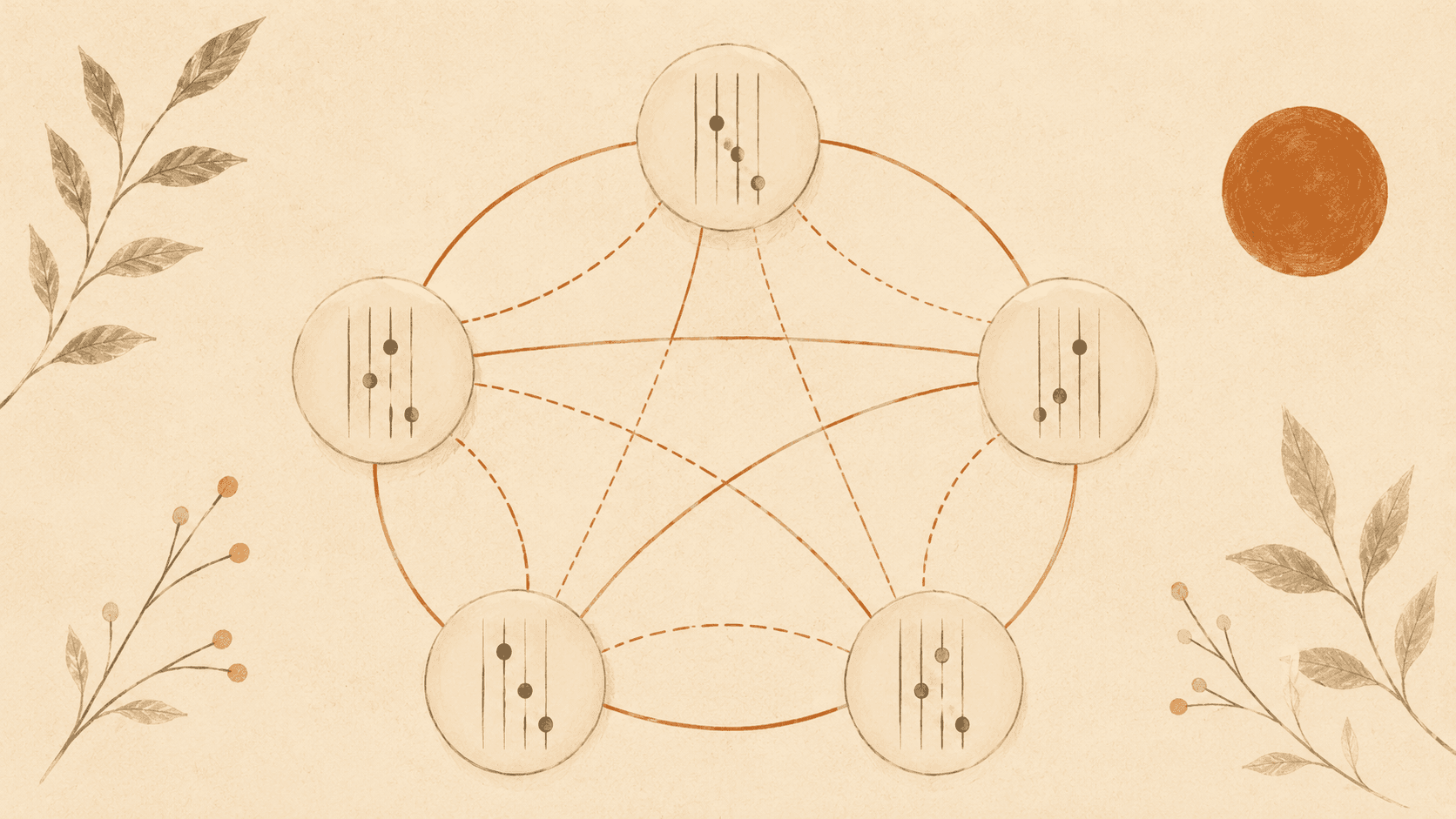
The chord shuffle: the intensive version of transition practice
Once you have 4–5 solid chords and their transitions, move on to the chord shuffle exercise. The idea: chords are drawn at random, in an order you do not know in advance, and you must chain them without any dead time. This is the real test, if you have practised Em-Am-C-G in that exact order for three months, that does not mean you can play C-Em-G-Am. The shuffle forces you to find every chord from every other starting point.
Doing this the old way requires a partner (who calls out chords) or a deck of cards you shuffle between rounds. Today a shuffle app (ours, in this case, but the principle applies to any app) draws the chords and listens through the microphone to check if you play them correctly. It turns the exercise into a game, which matters more than you might think: motivation is the number one factor in daily practice, and a mechanical drill loses its appeal fast.
Spaced repetition: why 5 minutes a day beats 1 hour a week
The science of memory is clear on this: spaced repetition beats massed practice decisively. Concretely, 5 minutes of practice every day for a week produces better retention than a single 35-minute session, for the same total time. It is counter-intuitive, but it holds just as well for language learning as for sports or music.
The mechanism is simple: between sessions, your brain consolidates what was worked on. Without that spacing, you work at surface level, your brain retains what you did two minutes ago, so you succeed, so you think you are learning. But the next day, without the session that solidified everything overnight, the information evaporates.
Practical takeaway: if you take a lesson once a week, the worst use of your time in between is cramming it all on Sunday evening. The best is 5–10 minutes every day. You do not need more.
Seven practical tips to truly memorise chords
- Say the chord name out loud as you play it. Ridiculous but effective: you link verbalisation to procedural memory. "E minor" + the movement of placing your fingers become a single memory.
- Close your eyes during the transition. Without the visual cue, you force your fingers to know the position. This is the ultimate memorisation test.
- Play slowly. Speed comes with automaticity. Trying to play fast before playing cleanly locks in bad habits, and a bad habit is harder to fix than a new movement to learn.
- Do not rely on watching your hands. Looking at your fingers constantly creates a visual dependency. Play sometimes without looking, even if it sounds rough.
- Use each chord in several songs. A chord encountered in only one song never "detaches" from that song. Find three songs that use it and alternate.
- Break down difficult transitions. If Bm is giving you trouble, do not force it. Work Em → Bm for 2 minutes, then Am → Bm for 2 minutes, then D → Bm. You anchor three transitions instead of one.
- Accept the bad days. Overnight consolidation does the work. A day when nothing clicks is sometimes followed by a day when everything flows, it is the night between the two that made it happen.
Try it in practice
You can start this method without any tools, paper, your guitar, and 10 minutes a day is enough. If you want to automate the random chord draws (the shuffle part) and get immediate feedback on whether you are playing correctly, that is exactly what Chord Shuffle was made for. Select the chords you know, launch a shuffle session, and your phone's microphone will listen and validate each chord. No account needed, it runs in the browser.
Conclusion: memorisation is structured practice
Nobody memorises a chord by reading about it. Nobody memorises a chord by playing it in isolation fifty times. We memorise by chaining it to other chords, in varied contexts, through short sessions repeated over several weeks. It is slow, not spectacular, and it is the only method that works. The good news: it really works, and it requires no special talent, just consistency.